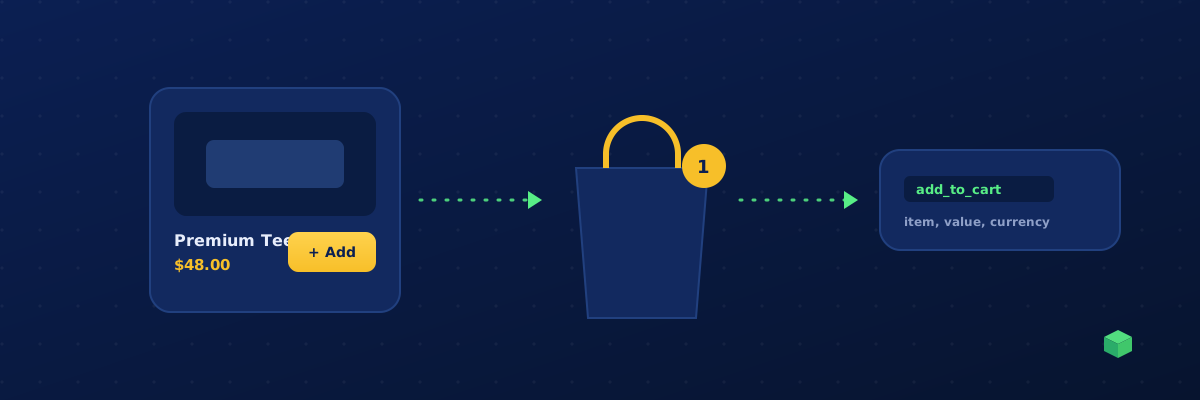
Add to cart is the second most valuable event in ecommerce tracking after purchase. It's the strongest pre-purchase intent signal you have, and it's the event Meta and Google use most for retargeting. Get it wrong and your retargeting audiences are wrong, your funnel reports are misleading, and your "add to cart conversion rate" metric is meaningless.
The GA4 Standard Event: add_to_cart
GA4 has a recommended event called add_to_cart that comes with a standard parameter schema. Using it correctly means your data will work with GA4's built-in ecommerce reports, the audience builder, and Google Ads automated bidding.
The full event looks like this in GA4 terms:
- event_name:
add_to_cart - currency: ISO currency code (USD, EUR, GBP, etc.)
- value: the monetary value of items added (price × quantity)
- items: an array of items, each containing
item_id,item_name,price,quantity, and optionallyitem_brand,item_category,item_variant
The items array is what most marketers get wrong. It's not optional. Without it, GA4 won't show this event in the Monetisation reports, the audience builder can't filter by product, and Google Ads can't use it for product-level targeting.
Detecting an Add-to-Cart Action
"Add to cart" is not a single action - it's about five different things depending on the platform and the theme. Here are all the cases your tracking needs to handle:
- Form submission: Traditional themes use a
<form>with a hidden product ID and quantity, submitted via POST. The form action contains/cart/addor similar. - AJAX (fetch): Modern themes intercept the form submit and use
fetch()to send the same data. The page doesn't reload. - AJAX (XHR): Older AJAX themes use
XMLHttpRequestinstead of fetch. Same goal, different API. - Direct buy / dynamic checkout: "Buy now" buttons that skip the cart entirely and go straight to checkout. These don't trigger any "add to cart" form action - they trigger a redirect.
- Cart drawer interactions: Some themes have a slide-out cart drawer where you can change quantities. Increasing the quantity is technically an "add to cart" but won't trigger any of the above.
If your tracking only catches case 1 (the form submission), you'll miss anywhere from 30% to 80% of add-to-cart events depending on your theme. This is by far the most common reason ecommerce tracking under-reports.
Getting the Product Data
Once you've detected an add-to-cart action, you need to populate the items array with the right product information. Where you get this data depends on the platform:
- BigCommerce: Read from the global
BCData.product_attributesobject. Easy. - WooCommerce: Read from the global
woocommerce_paramsobject plus the cart fragments returned by the AJAX response. - Shopify: Read from
window.Shopifyand the JSON-LDProductschema in the page head. - Magento 2: Read from
checkoutConfigand the data attributes on the product page. - Custom carts: Read from JSON-LD
Productmicrodata if present, or fall back to scraping the price and title from DOM elements with class names like.product__title,.price.
The fallback DOM scraping is messy but works for most stores. The price is usually inside an element with "price" in the class name. The product name is usually the H1 on the product page.
Avoiding Double-Counting
The downside of layered detection is that the same add-to-cart action might be caught by multiple layers. A user clicks "Add to cart", which triggers a form submit (Layer 1) and a fetch call (Layer 2) - that's two events for one action.
Solve this with debouncing: when an add-to-cart event fires, set a flag. If another fires within 1.5 seconds, ignore it. This catches almost all double-counting without missing real second adds.
Sending to Multiple Channels
You usually want add-to-cart tracking on three channels at once:
- GA4: for analytics and reporting
- Meta Pixel: as the standard event
AddToCartfor retargeting and lookalike audiences - Google Ads: as a conversion action for retargeting RLSA campaigns and Smart Bidding
Each platform uses a slightly different parameter name format (GA4 uses items, Meta uses contents, Google Ads uses neither - it just expects a value), but the underlying data is the same. With Tag Manager, you set up one trigger for the add-to-cart action, then create three tags that fire on it - one per platform - each formatting the data the way that platform expects.
Testing Add-to-Cart Tracking
Verify each path independently:
- Standard add to cart: Open a product page, click Add to Cart, check GA4 Realtime for the event with the right item ID and price.
- Quantity change: If your theme has a quantity input on the product page, set quantity to 3 and add to cart. The event should report quantity 3 and total value of 3× the price.
- Buy Now button: If your theme has a Buy Now / Dynamic Checkout button, click it. The add_to_cart event should still fire (treated as add+checkout combined).
- From the cart drawer: If your theme has a cart drawer with quantity adjusters, increase the quantity. This is a grey area - some merchants want to track this as an add, others don't. Decide your policy and verify it matches.
Skip the Setup
Add-to-cart tracking has a lot of edge cases per platform. TrackingCoder handles them automatically. Pick "Add to Cart", select GA4 + Meta + Google Ads as channels, and we generate a single GTM container with all the layered detection logic, the debouncing, and the right parameter formatting per channel. Most users have working multi-channel add-to-cart tracking in 5 minutes.